Saturday, May 6, 2023

Poetry Entry 7: Beings


Picture by Jaime Webb

I share these lands and 

waters with so many beings

I cannot even count

them all. Known in 

groups: animals, plants

fungi, protists

and bacteria.

What stories would they

share if I was able

to listen and understand?

Through my patience and

quiet noticing, I'm gifted

with a few pieces

of this larger puzzle.

Through my imagination

I picture these other

beings' lives.

I say hello to those

encountered and look

forward to meeting

the rest of life. 

Monday, January 23, 2023

Jaime's Thoughts 1: The Way We Think About Ecological Succession


Photo Citation: Sebastian Unrau


 The Way We Think About Ecological Succession

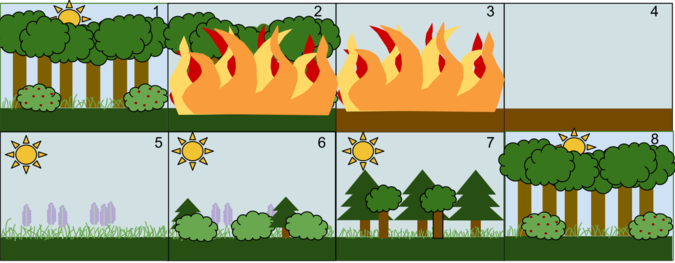
    Ecological Succession is defined as "the process of change in the species structure of an ecological community over time" which is caused by species interactions within this ecological community and the environment (Wikipedia). A common example of ecological succession is the forest succession process where a clearing is created in a forest due to a disturbance, say a fire or flood, then slowly becomes a shrubland then young trees then older trees and then a forest composed of older trees, young trees, and undergrowth such as shrubs, grasses, flowers, etc. An example can be seen in the photo from Wikipedia down below.


    The way we think about ecological succession in the academic sciences though is full of language from western culture that is related to social and environmental harm. The first species to grow in a disturbed area are currently called Pioneer Species who are said to colonize the land when they arrive first to a disturbed area. Manifest Destiny, and America's support of pioneers/settlers in history, aimed to conquer the wilderness and violently removed Indigenous people from the land as a part of colonization. The act of colonizing the land was NOT beneficial to the ecological communities as forests were cleared, prairies were plowed, wetlands were polluted by livestock, and predators were exterminated and many prey animals over-hunted. This is a far cry from the way pioneer species who are the first to live on disturbed landscapes often actually improve the stability of the ecosystem and pave the way for the following steps of ecological succession. 

    For example, during Primary Succession where there is zero or almost no soil, lichens are the first to arrive and over time, contribute to the creation of soil which allows other species to then live there. During Secondary Succession where there was a disturbance, some early arrival plants such as red alder are nitrogen fixers who help increase the amount of nitrogen in the soil, a nutrient that is vital to plants but is very limited. 

    Due to this connection between the historical pioneers and their contributions to environmental harm through colonization, I propose that pioneer species be renamed to something that reflects their ecosystem benefits more holistically. One potential word could be Initiators as they are the first to arrive at a disturbed site and initiate ecosystem changes. Since not all species who arrive at a disturbed site will inherently support the species that follow, they could also simply be called Early Successional Arrivals. as that succinctly describes how they are first to arrive and thrive. Initiators could be reserved for species such as lichens and red alder who do help support the succession stages. 

    Currently, the end of the succession stage is called a Climax Community, such as an Oak-Hickory Forest in the Midwest states. This is seen as an end state since the community went from grassland to forest. However, disturbance such as a fire can restart the succession process all over again or there may be several different potential climax states. For example, an Oak-Hickory Forest can become a different type of forest made up of different tree species. Some people do already use Equilibrium Species rather than climax species since the community's species composition only remains that way while it is in equilibrium, and is subject to change. Rather than viewing certain end states as a climax that is inherently supposed to remain, it is better to view ecological communities as constantly in flux at different stages of succession. After all, having only forest and no mixed forest and grasslands would not be able to support as much biodiversity.

    Using words to talk about ecological succession that focus on the species' interactions without using words that are based in themes of control/domination or being static as pioneer and climax do, helps to improve our own understanding of the ways ecosystems and ecological communities work while removing language with that violent history. 

I have a BA in Environmental Science and MA in Environmental Education and so I have not cited a lot of sources as this is a rather informal blog for my thoughts and I have a lot of professional knowledge about these topics. I have included a few links below though for your own curiosity if you want to learn more about these topics. 

Works Cited

Monday, December 19, 2022

Art Entry 3: Nature Journaling 2


My favorite finds these past few months were the two salamanders found on one of my workplace's preserves. I find these creatures fascinating and beautiful! (Please not that if you find salamanders in the wild it is best to leave them alone as their bodies are very fragile, we are trained professionals! And also b/c human skin can be toxic to them when held for very long.)

Seeing my first ever salmon run was also amazing as well! It is one thing to learn about the life cycle of salmon and how they support 137 other species in their ecosystems while in college in the Midwest, it's quite another thing to witness individual fish's struggle to swim upstream and to see their decomposing bodies after spawning. And yes they do smell lol. 


Thursday, December 15, 2022

Poetry Entry 6: Mutualism


Photo of a conifer planted in a grove of red alder 

 Nature is red in tooth and claw,
so the old saying goes.
Older knowledge still says
welcoming roots and partnerships
are bound in nature as well.

Red alder trees fix nitrogen in soils
which benefit the next generation of plants.
Mycorrhizal networks below ground
connect trees such as the red alder
and pine who wish to share nutrients between species.
We could learn from this generous reciprocity. 

In the oceans coral grows firm,
sheltering photosynthetic zooxanthellae algae 
who in return shares their sugars
and gives the coral its beautiful colors,
reminding us that we glow brighter
when working together.

Fig trees employ aromatic signals
to draw in female fig wasps
to ready and waiting fruits with flowers inside.
The fig wasp burrows inside the narrow tunnel,
often losing her wings and even antenna
so that she can lay her eggs and pollinate the flowers
before finally expiring. 
A story of parental fortitude. 

Our own human ancestors
built relationships with the honeyguide,
a bird who through song and movement
flitting from tree to tree
guided listening humans to a hive
filled with golden, delicious treasure.

If we just listen and observe,
nature and evolutionary history have just as many stories
of community and mutuality as they do of competition. 

Tuesday, August 23, 2022

Poetry Entry 5: Kin of the Month

   Anakin Skywalker live action         Dream of the Endless, Netflix         Adrian Chase in his suit, from Peacemaker show  Will Graham in a sweater from Hannibal show

I was inspired to write this poem today because I was thinking about why I kin so many different male characters, and how last year that helped me to come to realize that I was a transmasc person rather than just nonbinary. For some people, kinning isn't that deep, but I feel like for some of us when we say "I kin them" we are saying a lot with a few words.  

Kin of the Month

What is the essence of these men

that captures my heart's attention

and my brains' intense focus?

Surely part of it is gender envy.

I desire their dark, scruffy hair,

lanky libs, five o'clock shadow,

soft yet deep voices.

Do I relish their successes 

as gods, heroes, detectives, babysitters?

I relate to their questioning,

their struggles on the heros journey

as they find their place in fantastical worlds.

They are the mirror, reflecting back to me

my inner, true self.

They represent my future,

a comfort during a time of transition.

Peter Parker. Dream of the Endless.

Bucky Barnes. Will Graham.

Spencer Reid. Anakin Skywalker.

Steve Harrington. Adrian Chase.

Ben Wyatt. Din Djarin.

As I claim my comfort characters,

pieces of myself long denied I also claim:

masculinity, strength

relationships, humor

confidence, autistic joy.

To express all this emotion and love I say:

I kin him. 

Thursday, August 11, 2022

Art Entry 2: Nature's Pride Flag

Columns of differenet pictures based on colors of the rainbow from left to right. Starting with red berries, orange berries, yellow flowers, green moss & grass, blue flowers, and purple and pink flowers
Title of Artwork: Nature's Pride Flag

 Back during Pride Month I led a special hike to celebrate diversity in conservation at my job. One of the projects I did with my adult class was have everyone take photos during the short hike, challenging them to try to get all the different colors of the rainbow so that we could create a rainbow using their photos. 

Later after the class, I assembled a combination of photos I took and the participants' who shared photos. As you can probably see, some colors are much harder to find during a Pacific Northwest Summer than others, particularly blue which I was lucky to spot tiny blue flowers near the pond. 

Did you spot the only lifeform in the photo? I couldn't resist including a yellow bee as bees are one of my favorite living creatures. 

At the end of the hike, I also passed out a brochure I had made about various Queer Environmental Leaders who have contributed to the environmental movement overall, science, or environmental justice. As a queer environmental scientist and educator myself, I have always been drawn to the diversity in nature and how that is reflected back in our human communities, as we are a part of nature.

Many of the people in the brochure below have blogs, books, social medias, scientific papers, or organizations where people can learn about the work they have done and that is why I chose them to be highlighted. There are many more passionate, brilliant Queer Environmental Leaders for us to learn from. 


Sunday, August 7, 2022

Poetry Entry 4:

Photo of space
Photo Source: https://www.unoosa.org/oosa/en/timeline/index.html


One book that I really enjoyed reading during the winter last year was The Wakeful World: Animism, Mind and the Self in Nature by Emma Restall Orr. Let's just say this book made my brain hurt sometimes, my curiosity stir, and supported my already growing appreciation for the ways mutuality governs life. It was while reading this book that I was inspired to write the poem below on Nov 5, 2021:

Dust 

I am a part of something larger than myself

Because an infinity of individuals

Make up this body I call ME.

This SELF I claim is really a WE.

A community of cells, bacteria,

Atoms, flying electrons.

Together we are a me,

Both human and more-than-human

Existing in a sea of other selves

Fluctuating in patterns

Of order and chaos

Interacting through relationships

Communicated via energy. 


Art Entry 4: Nature Journaling 3

Wow since the last time I blogged so much has changed! I finished my AmeriCorps service year in WA, moved back in with my mother while worki...